

In the aftermath of severe storms, those close to the affected areas are often left wondering, “How can we help?” In the world of electric cooperatives, 1 unique form of help comes in the form of mutual aid.
Mutual aid is a collaborative approach to emergency planning. The mutual aid model allows electric co-ops to help each other during times of need. This approach permits co-ops to “borrow” restoration workers from other co-ops, increasing the workforce response to areas affected by a major outage event. It’s essentially about neighbors helping neighbors, whether those neighbors are located in nearby communities, or fellow co-ops located hundreds of miles away.
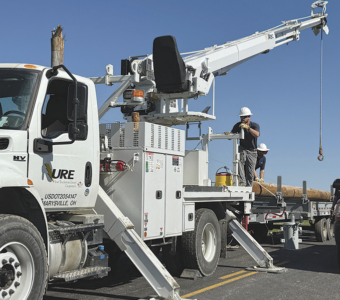
After a recent storm left more than a thousand members without power, crews from URE traveled to western Ohio to Midwest Electric to help the co-op restore power to its members. Linemen Sam Bevis, Sam Passwaters, Will Culbertson, and Cody Lindsey joined the restoration efforts. The crew’s arrival helped Midwest Electric lineworkers get some much-needed rest as they had worked through the night to clear debris and repair damage, including 4 broken transmission poles and 28 broken distribution poles. The group was able to return home safely the same day, as the final outages were being restored in the area. This is just 1 of the many examples of cooperatives lending a helping hand to 1 another.
Electric co-ops operate according to 7 principles, and principles 6 and 7, Cooperation among Cooperatives and Concern for the Community, are directly connected to the mutual aid model.
Electric co-ops were formed to provide reliable electric service to their members at the lowest reasonable cost, and mutual aid has been a fundamental part of our DNA since co-ops were formed. The concept of mutual aid originated with the rural electrification efforts in the 1930s. From the very beginning, electric co-ops relied on each other to assist in times of need, and mutual aid provides an essential safety net in times of crisis.
Mutual aid ultimately benefits co-op members. During major outage events, co-ops can increase their workforce and respond more quickly, leading to shorter outage times for members.
Disaster response and mutual aid are managed by electric co-ops and their statewide organizations, which assist in coordinating mutual aid between states. These efforts require effective logistics management and experts who fully understand resource allocation and have the know-how to respond under pressure.
During major outage events, restoration teams require a variety of equipment, including bucket trucks and other specialized vehicles, utility poles, transformers, and wires. Skilled lineworkers, tree-trimmers, damage assessors, and other key personnel are also often shared among co-ops. These experts provide critical skills and manpower to speed up the restoration process.
By sharing resources, co-ops can significantly enhance their response capabilities. In essence, mutual aid embodies the 6th cooperative principle of “Cooperation Among Cooperatives” and ensures that members receive reliable electricity even in the face of major challenges.